
Introduction:
The Changing Reality of the Software Industry: Why Students Are Struggling to Get Jobs – And What We Must Do Next – For many years, the software industry was considered the safest and fastest path to career success. Students across the world rushed into computer science, coding boot camps, and IT-related degrees with the belief that software jobs would continue growing endlessly.
But today, the situation is changing dramatically.
“Thousands of students” became recent graduates, entering students, or broad segments of the workforce. Layoffs are increasing, hiring has slowed in many sectors, automation is replacing repetitive tasks, and artificial intelligence is changing the nature of software work itself.
This is not merely a temporary slowdown. It is a transformation.
The question is no longer:
“How do I get a software job?”
The real question has become:
” How do I continuously reinvent my career to match the speed of global progress?”
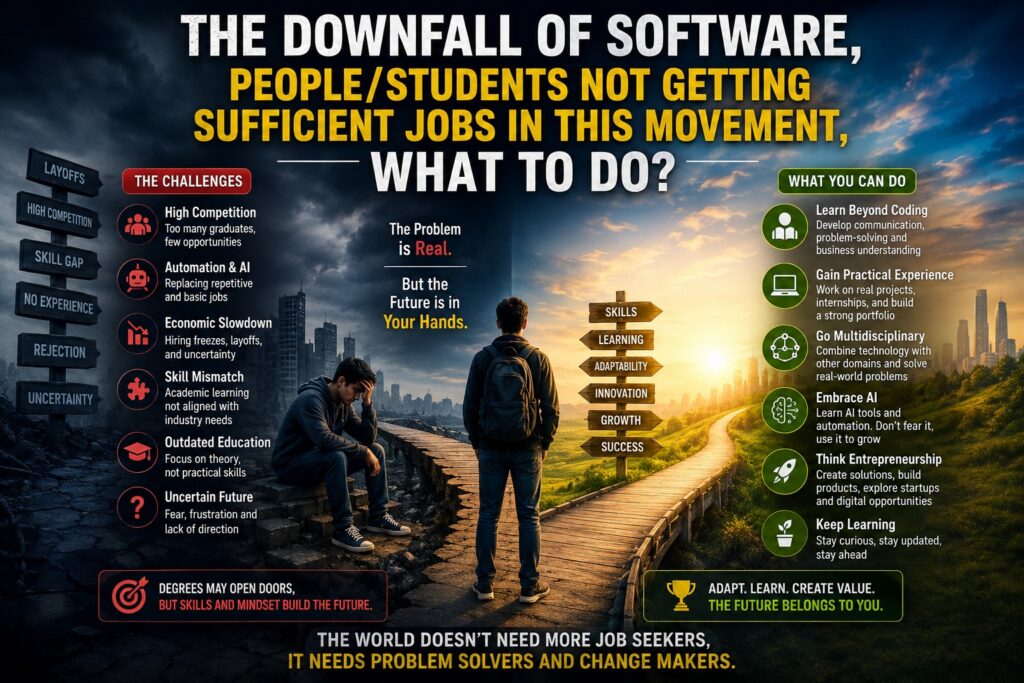
Why the Software Sector is stumbling
The software sector is not disappearing, but it is evolving faster than many expected.
Several major factors are contributing to the current challenges:
1. Oversupply of Graduates
Every year, millions of students enter software-related fields. Colleges, online courses, and training institutes produce a huge number of graduates with similar skills.
However, industry demand is no longer growing at the same speed.
As a result:
- Competition has increased sharply
- Entry-level jobs have reduced
- Many candidates possess only basic coding skills
A degree alone is no longer enough.
2. Automation and Artificial Intelligence
AI tools can now generate code, automate testing, write documentation, and solve basic programming tasks.
Companies are beginning to ask:
- Why hire large teams for repetitive work?
- Why pay for tasks that automation can handle?
This especially affects:
- Basic coding roles
- Repetitive support work
- Low-level testing jobs
The future belongs to professionals who can solve complex problems—not just follow instructions.
3. Economic Slowdowns and Global Uncertainty
Many global companies are reducing spending due to economic uncertainty.
As a result:
- Hiring freezes have increased
- Startups are becoming cautious
- Cost-cutting measures are affecting IT teams
Even highly skilled professionals are facing longer job searches.
4. Skill Mismatch Between Education and Industry
One of the biggest problems is that many students learn theory but lack practical exposure.
Industries need people who can:
- Solve real-world problems
- Work on live projects
- Communicate effectively
- Adapt quickly
Unfortunately, many educational systems still focus heavily on exams instead of practical capability.
“The Bigger Truth” is replaced with the underlying reality, beyond the code, or the real takeaway.
The Changing Reality of the Software Industry: The deeper issue is not the downfall of software.
The real issue is the downfall of outdated learning models.
For years, society encouraged students to:
- Memorize
- Get marks
- Earn degrees
- Follow “safe” career paths
But the modern world rewards something different:
- Creativity
- Adaptability
- Problem-solving
- Communication
- Innovation
- Multidisciplinary thinking
The future belongs to flexible learners, not rigid degree holders.
What Students Must Do Now
Instead of panicking, students and professionals must adapt intelligently.
1. Learn Beyond Coding
Coding is important, but it is only one skill.
Students should also develop:
- Communication skills
- Business understanding
- Problem-solving ability
- Critical thinking
- Leadership qualities
Technology alone does not build careers.
Human value does.
2. Build Practical Experience
Practical knowledge matters more than certificates.
Students should:
- Work on real projects
- Build portfolios
- Contribute to open-source projects
- Create small products or applications
- Take internships seriously
Experience creates confidence.
3. Become Multidisciplinary
The future favours people who combine technology with other domains.
Examples include:
- AI + Healthcare
- Software + Manufacturing
- Data + Agriculture
- Technology + Education
- AI + Pharma
Students should explore industries beyond pure IT.
Those who solve industry problems will always remain valuable.
4. Learn AI Instead of Fearing It
Artificial Intelligence is not only a threat—it is also an opportunity.
Students should learn:
- AI tools
- Prompt engineering
- Automation systems
- Data analysis
- AI-assisted productivity
The winners will be those who work with AI, not against it.
5. Focus on Entrepreneurship and Innovation
Not everyone must depend only on jobs.
Students can also explore:
- Freelancing
- Consulting
- Start-ups
- Digital products
- Online education
- Technical content creation
The internet has created new opportunities beyond traditional employment.
Innovation creates independence.
What Educational Institutions Must Change
Colleges and universities also need transformation.
Education should move from:
- Memorization → Practical learning
- Degrees → Skills
- Theory → Problem-solving
- Fear → Creativity
Institutions must:
- Collaborate with industries
- Encourage internships
- Teach AI and emerging technologies
- Promote entrepreneurship
- Support multidisciplinary learning
Educational systems must equip learners for tomorrow’s realities rather than yesterday’s standards.
What Parents Must Understand
Many parents still push children toward “safe” careers without understanding industry realities.
The world has changed.
Success today depends less on degree titles and more on adaptability and continuous learning.
Parents should encourage:
- Skill development
- Creativity
- Curiosity
- Real-world exposure
Pressure without direction creates frustration.
Support creates confidence.
The Future Still Belongs to Learners
Despite all the challenges, opportunities still exist.
Technology is not ending.
Industries are still growing.
New fields are emerging every year:
- Artificial Intelligence
- Robotics
- Renewable Energy
- Biotechnology
- AR/VR/XR
- Healthcare Technology
- Pharma Manufacturing Technology
- Cybersecurity
- Sustainable Engineering
Tomorrow’s opportunities will inevitably favour individuals committed to lifelong learning.
Final Thoughts
The Changing Reality of the Software Industry: The software industry is not collapsing—it is transforming.
What is disappearing are repetitive, low-value roles.
What is rising are high-value skills:
- Creativity
- Innovation
- Adaptability
- Practical problem-solving
- Human intelligence combined with technology
This moment should not create fear.
It should create awakening.
Students must stop preparing only for jobs and start preparing for value creation.
The world no longer rewards only degrees.
It rewards people who can think, adapt, solve, and innovate.
The future will belong not to those who simply studied software—
but to those who continuously evolve with the changing world.